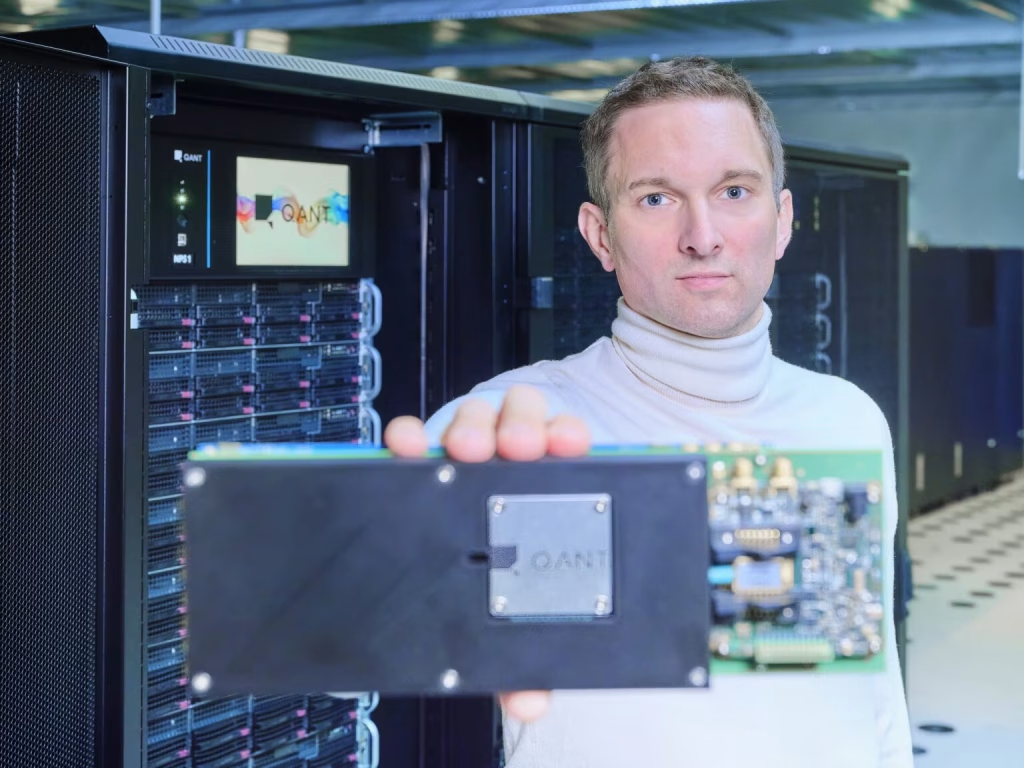
Stuttgart-based startup Q.ANT has raised €62 million in what is being called the largest Series A round for photonic computing in Europe. The deep tech company, founded in 2018 as a spin-off from TRUMPF, is developing next-generation processors that compute using light instead of electricity. This breakthrough could drastically reduce energy consumption and boost performance in artificial intelligence and high-performance computing workloads.
The funding round is co-led by Cherry Ventures, UVC Partners, and imec.xpand, with participation from institutional backers like L-Bank and Venionaire Capital. The goal is to accelerate the commercialization of Q.ANT’s Thin-Film Lithium Niobate-based photonic processors, which the company says can integrate seamlessly into existing data center infrastructure as co-processors. These chips have demonstrated up to 30 times better energy efficiency and 50 times faster performance in real-world AI tasks, according to internal tests.
Dr. Michael Förtsch, CEO and founder of Q.ANT, said the company was created to fundamentally change how computation works. “This investment proves that Europe has both the ambition and capital to lead,” Förtsch said. “It gives us strong partners to help shape the future of computing.”
Traditional silicon-based CMOS processors are reaching physical and efficiency limitations, especially as AI infrastructure rapidly scales. A report by the International Energy Agency forecasts that data center energy consumption will exceed Japan’s total electricity usage by 2026. Q.ANT’s photonic approach offers a promising alternative by reducing the need for power-hungry cooling systems and dramatically increasing compute density.
The company’s Native Processing Server (NPS) is already available for early access and can run existing AI and high-performance computing software without requiring significant architectural changes. The NPS is designed to plug directly into current systems and supports major programming languages and frameworks.
The funding will also support Q.ANT’s international expansion, especially into the United States. To guide its next phase, Q.ANT has added seasoned industry veterans to its advisory board, including ARM founder Hermann Hauser and former Intel executive Hermann Eul. Their experience in scaling semiconductor businesses is expected to be instrumental in Q.ANT’s growth.
Christian Meermann of Cherry Ventures described Q.ANT’s chips as a game-changer for data centers, reducing operational costs while delivering the power needed for the next generation of computing. UVC Partners’ Andreas Unseld highlighted Q.ANT’s ability to combine long-term sustainability goals with deep tech execution, a rare combination in the industry.
Imec.xpand’s Cyril Vancura called the company a clear frontrunner in overcoming the scaling limitations of conventional processors. “Photonic computing represents a fundamentally new paradigm with immense, largely untapped potential,” he said.
Q.ANT operates its own photonic chip pilot line in collaboration with the Institute for Microelectronics Stuttgart and is already shipping products to select customers. It is aiming to make photonic computing a foundational pillar of global AI infrastructure by 2030.
Experts in the semiconductor and AI sectors are taking note. Bob Sorensen of Hyperion Research said Q.ANT has managed to tackle two of photonic computing’s biggest challenges—precision and integration—while demonstrating 99.7% accuracy on photonic chips for complex AI tasks. This proves, he said, that analog light-based computing can be both accurate and commercially viable.
The public sector is also expressing support. L-Bank’s Johannes Heinloth emphasized the potential of Q.ANT’s work to drive economic growth and innovation in the Baden-Württemberg region. Berthold Schmidt, CTO at TRUMPF, noted the deep tech disruption being driven by the company and praised Q.ANT’s ability to move from vision to commercialization. Meanwhile, Manfred Rauhmeier of acatech applauded Q.ANT’s success as an example of coordinated innovation across research, industry, and policy.
Discover more from Semiconductors Insight
Subscribe to get the latest posts sent to your email.


